|
In This Issue
I'm in Atlanta and ready to go onstage. One thing this keynote preparation reminded me about AI and human work.
Did AI give you time back? My take on this week's warning that AI could threaten humanity by 2030.
Three open doors. A remote AI adoption role, an international speaking call, and a pitch competition open across twelve countries.
|
Atlanta, right now
I'm in Atlanta right now, ready to go onstage for the National Sales Network Student Conference.
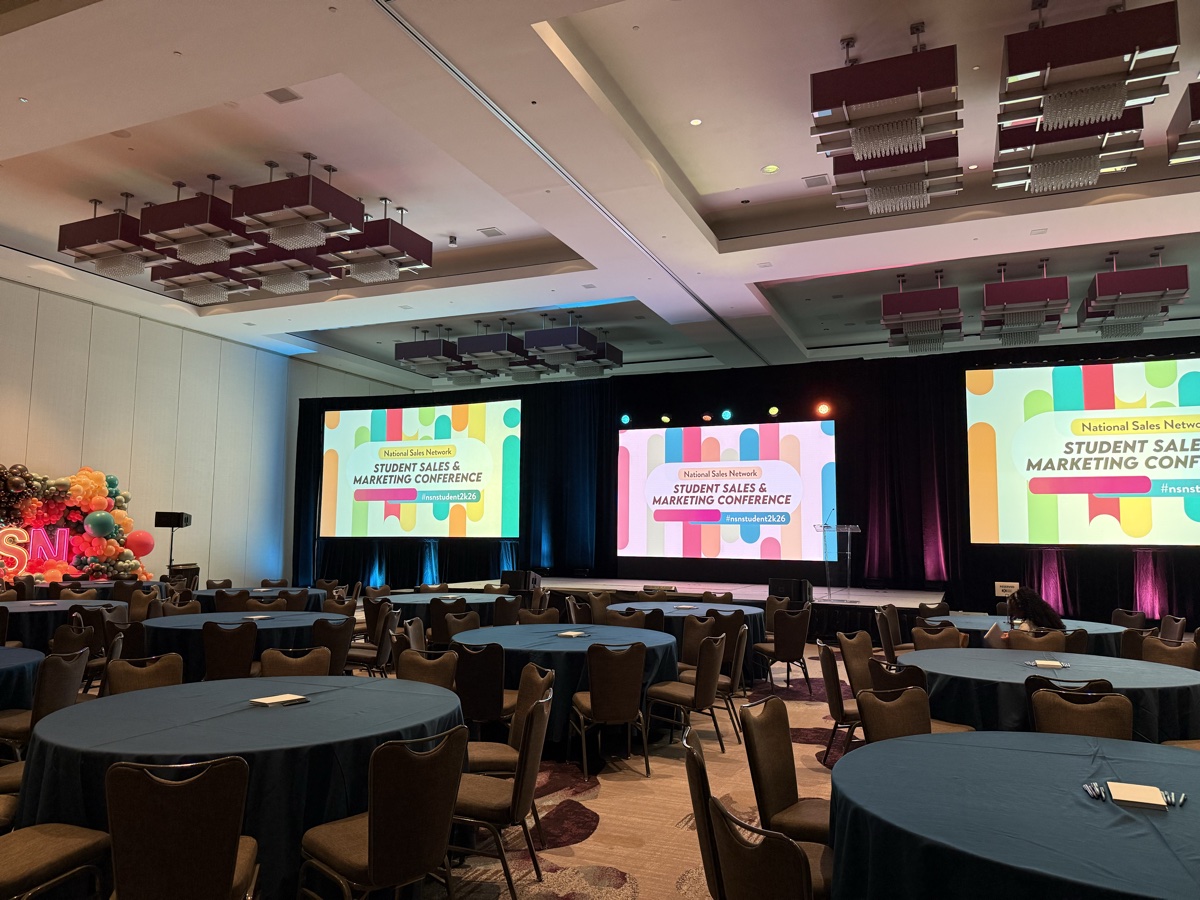 The stage during mic check in Atlanta.
|
I've been so busy and back to back with priorities that I had to work out what this keynote was going to be over the last month, then bring all of it together this week.
At first, I was trying to memorize every sentence of a thirty-minute speech. That was too much, and it wasn't even how I wanted to show up.
My best bet was to know the stories, know the point of each section, and teach from the stage. AI helped me organize the speech into four parts and build checkpoints so I always knew where I was.
It can help me prepare. I still have to walk onstage, read the room, tell the stories, and make it mean something.
That's the point I'm taking with me today.
I'm also going to keep these Sunday newsletters shorter moving forward. One clear idea. Something you can read and use in a few minutes. Short and sweet.
Did AI give you time back?
This week's podcast starts with something I keep returning to: if we're lucky, we get about eighty summers.
That's why AI fascinates me. I want it to compress the time between where we are and the money, resources, work, or opportunities we need. I want the work to take less of the life.
Then this week, Jacob Coxon resigned from Anthropic. He said he spent the last three years doing research at both OpenAI and Anthropic, and warned that some of the people building AI believe it could threaten humanity by the end of the decade.
I don't know which models he's seen inside those labs or exactly where they're going. I'm not going to pretend I do. AI is already doing amazing things, so I take the warning seriously.
I also know what I can see. The AI employees I build can carry a lot of work, but they still need supervision. Some need me in the loop constantly while the role is new. Even the strongest need at least a weekly check-in so I can update their context, review what happened, and correct what drifted.
When I see agents deployed inside some of the biggest enterprises, they don't arrive alone. They bring in different teams. Somebody has to connect them to real systems, decide what they can access, protect the data, review the work, and own the outcome.
I think more of us are becoming orchestrators. We won't do every task ourselves, but we'll manage teams of AI employees, set priorities, check the work, and make the final decisions. That changes jobs. It doesn't automatically give us our time back.
And AI still has to run somewhere. It needs electricity, chips, data centers, networks, cooling, and people to build and maintain all of it. If AI becomes as capable as some insiders expect, who creates and controls the resources it needs to keep running?
I'm acting on what I can control now: get your resources up. Learn how to direct AI. Build income and assets that give you choices. Get some land if you can. Grow some food. Touch dirt. Spend days the way you want to spend them.
I'm going to Aruba in a month. I plan to enjoy my life.
That's the question underneath this week's episode. AI can make us faster, but if every saved minute fills up with more work, it hasn't returned anything to our actual lives.
|
ONE THING TO DO TODAY
Pick one task you already do and time the whole process before and after AI. Include the time you spend prompting, checking, correcting, and moving the work where it needs to go. If AI saved thirty minutes, decide where those thirty minutes will go before something else claims them.
|
|
BRING CONTEXT TRAINING TO YOUR ORGANIZATION
If your organization is trying to move people from trying AI to using it well in their actual work, bring me in for a Context Training keynote or workshop.
Book me for your organization →
|
| GRANTS, SPEAKING, AND JOB OPPORTUNITIES |
Three open doors
|
What: Lead onboarding and AI adoption for personal-injury law firms · Pay: $195,000 to $240,000, plus equity · Where: Remote in the United States with regular travel · For: Leaders with at least eight years in onboarding, implementation, customer success, operations, or related work
|
|
What: Submit a session on AI, Copilot, digital transformation, change management, or user adoption · Deadline: October 20 · Paid: Not stated · Where: Auckland, New Zealand, March 16 to 17, 2027
|
|
What: Submit a sixty-second video pitch for a $2,500 cash prize · Deadline: September 30 · Cost: Free · For: Founders in twelve eligible countries whose startups have received no more than $250,000 in outside funding
The eligible countries include the United States, Canada, the United Kingdom, Ireland, the Netherlands, Australia, New Zealand, Israel, India, Singapore, Japan, and South Korea.
|
This is the fuller conversation about why I want AI to help us keep more of our finite time for living, how it can shorten the path to something we need, and why human judgment still belongs in the work.
Listen to the episode →
The AI, podcast, book, and workflow tools behind Seed & Society.
Browse the Seed & Society resources →
Until next time, continue planting the Seeds for a better Society.
Makeda
Forward this to the person managing more AI tools and wondering where the saved time went. 🦋
The content shared by Seed & Society® is for informational and educational purposes only. Nothing here constitutes financial, investment, or legal advice. All opinions expressed are my own and don't reflect the views of my employer.
|